
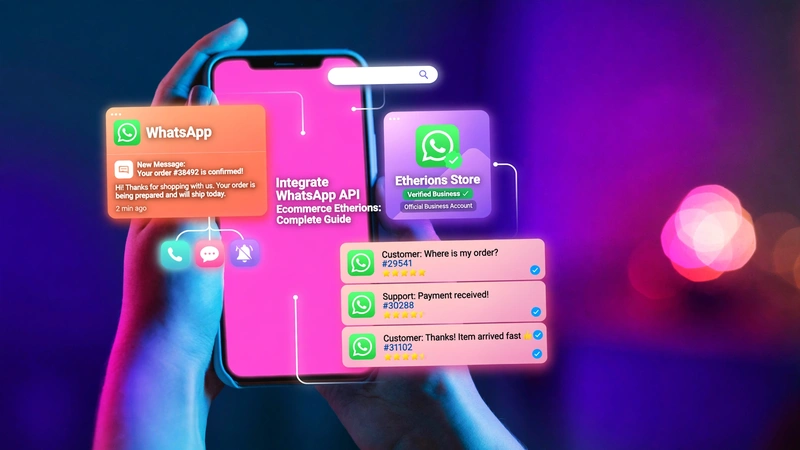
Ecommerce has changed the way businesses communicate with customers. Online shoppers increasingly expect quick answers, order updates, product information, and convenient customer support without having to leave their preferred messaging platform. For ecommerce businesses exploring blockchain and digital technology, WhatsApp can become an important communication channel when it is connected properly with an online store.
The phrase integrate whatsapp api ecommerce etherions brings together three important areas: WhatsApp Business API, ecommerce communication, and the Etherions technology ecosystem. Understanding how these areas can work together helps businesses think about better customer communication, automation, order notifications, and digital experiences.
WhatsApp Business provides tools for businesses to communicate with customers, while its platform includes APIs such as the Cloud API hosted by Meta. Businesses must follow WhatsApp’s messaging, commerce, privacy, and consent requirements when using these services.
This guide explains the main concepts, potential ecommerce applications, integration considerations, automation opportunities, security concerns, and important points businesses should understand before building a WhatsApp-based ecommerce communication system.
What Does Integrate WhatsApp API Ecommerce Etherions Mean?
The phrase integrate whatsapp api ecommerce etherions can describe an approach where an ecommerce website connects WhatsApp Business messaging with digital commerce technology associated with Etherions.
The goal is not simply to add a WhatsApp button to a website. A deeper integration can connect customer interactions with ecommerce events such as:
- New orders
- Order confirmations
- Shipping updates
- Customer questions
- Product inquiries
- Support requests
- Stock-related information
- Payment-related notifications
- Post-purchase communication
A properly designed system can allow information to move between the ecommerce platform and WhatsApp while keeping customer communication organized.
The exact technical architecture will depend on the ecommerce platform, backend system, WhatsApp Business setup, and the specific Etherions services being used.
Why WhatsApp Matters for Ecommerce
WhatsApp is widely used for direct communication, making it attractive to ecommerce businesses that want to reduce communication friction.
Instead of requiring customers to repeatedly check an email inbox or website dashboard, a business can use WhatsApp for permitted notifications and customer conversations.
Common ecommerce communication examples include:
Order Confirmation
After a customer completes an order, the ecommerce system can trigger an appropriate confirmation message.
Shipping Updates
Customers can receive updates when an order moves through different stages of fulfillment.
Customer Support
Customers can ask questions about products, orders, delivery, or general store information.
Product Communication
Businesses can use approved messaging experiences to provide relevant product information to customers who have opted in to receive those communications.
WhatsApp’s policies require businesses to obtain appropriate consent before sending messages and to respect opt-out requests.
How an Ecommerce WhatsApp API Integration Works
A basic architecture can contain several connected components.
Customer → Ecommerce Website → Ecommerce Backend → WhatsApp Business Platform → Customer
The ecommerce website collects the customer’s order or inquiry. The backend processes the relevant event and determines whether a WhatsApp communication should be triggered.
The WhatsApp Business Platform then handles the approved communication channel.
If Etherions-related infrastructure or applications are part of the broader system, those components can be integrated at the backend or application layer according to their available technical interfaces.
The important principle is to keep each component responsible for a clear function.
Key Components of the Integration
When businesses plan to integrate whatsapp api ecommerce etherions, several technical components should be considered.
WhatsApp Business Platform
The WhatsApp Business Platform provides the business messaging infrastructure required for more advanced integrations.
Meta’s policies specifically cover WhatsApp Business APIs, including the Cloud API.
Ecommerce Platform
The online store manages products, customers, orders, inventory, and checkout.
Backend Application
The backend connects ecommerce events with communication services. It can determine when a message should be triggered and what information needs to be included.
Database
Customer and order information may be stored in a database. Businesses need appropriate security and privacy controls around this information.
Etherions Technology
If Etherions-related technology is being used, it can potentially form part of the broader digital architecture, depending on the specific platform, APIs, and services available.
The integration should be based on documented capabilities rather than assumptions about what a platform supports.
Order Notifications Through WhatsApp
One of the clearest ecommerce use cases is order communication.
For example, an ecommerce system can detect an order event and prepare a customer notification.
A basic workflow could look like this:
- Customer completes an order.
- Ecommerce platform records the transaction.
- Backend receives the order event.
- System checks the customer’s messaging permissions.
- An appropriate WhatsApp message is selected.
- The message is sent through the WhatsApp Business Platform.
- Customer receives the notification.
- Support staff can handle follow-up questions.
This type of workflow can reduce repetitive manual communication while keeping customers informed.
However, businesses should not send messages simply because they possess a customer’s phone number. WhatsApp’s policy requires explicit consent for subsequent messaging, and businesses must respect requests to stop receiving communications.
Customer Support and Automation
Automation can make ecommerce support more efficient when it is designed carefully.
A WhatsApp integration could help answer common questions about:
- Store hours
- Product availability
- Shipping information
- Order status
- Return policies
- General product details
Automated responses can handle simple requests, while complicated questions can be transferred to a human support representative.
WhatsApp’s current policy allows automated responses within the applicable customer-service window but requires businesses to provide clear escalation options when human assistance is needed.
This makes human support an important part of the overall system rather than treating automation as a complete replacement.
WhatsApp Templates and Business-Initiated Messages
A major consideration is WhatsApp message templates.
Businesses cannot simply send unlimited promotional or automated messages whenever they want. WhatsApp’s platform policies state that business-initiated conversations must use approved message templates. Within the 24-hour customer-service window after a user’s message, businesses can respond without using a template, subject to the applicable rules.
For ecommerce businesses, templates may be relevant for approved communication categories such as:
- Order updates
- Shipping notifications
- Customer service
- Relevant offers
- Product-related communication
The business should clearly communicate what customers are agreeing to receive and provide understandable ways to opt out.
Privacy and Customer Data
Privacy is one of the most important parts of any ecommerce API integration.
An ecommerce business may handle names, phone numbers, order information, addresses, and other customer data. These details should be protected through appropriate security practices.
WhatsApp’s policy places responsibility on businesses to obtain required permissions, provide appropriate privacy notices, and comply with applicable laws. It also prohibits requesting or sharing sensitive information such as complete payment-card numbers and certain personal identifiers through WhatsApp.
A responsible integration should therefore include:
- Secure API credentials
- Access controls
- Data minimization
- Appropriate privacy policies
- Secure databases
- Controlled employee access
- Clear retention practices
- Regular security reviews
Ecommerce and Etherions Technology
The Etherions part of integrate whatsapp api ecommerce etherions can be understood as a broader technology layer rather than simply a messaging feature.
Depending on the actual Etherions infrastructure being used, a digital commerce system could potentially connect messaging, ecommerce applications, APIs, and blockchain-related services.
For example, a business could design an architecture where:
Ecommerce Layer → Backend/API Layer → Digital Infrastructure → WhatsApp Communication
The exact implementation depends on available APIs and documented platform capabilities.
This is important because good integration starts with real technical documentation rather than assuming that every platform can automatically connect with every other service.
Benefits for Ecommerce Businesses
A well-designed WhatsApp API integration can offer several practical benefits.
Faster Communication
Customers can receive relevant updates through a familiar communication channel.
Better Customer Experience
Quick answers and useful notifications can reduce unnecessary friction during the buying process.
Less Manual Work
Automated workflows can reduce repetitive customer-service tasks.
Centralized Communication
Businesses can connect ecommerce events with a structured messaging system.
Scalable Support
As order volume grows, automation can handle simple repetitive interactions while human agents focus on more complex cases.
Better Follow-Up
Businesses can maintain organized post-purchase communication when customers have provided the appropriate consent.
These benefits depend on implementation quality, customer expectations, and compliance with WhatsApp policies.
Common Integration Challenges
Businesses should also understand the limitations.
Technical Complexity
Connecting an ecommerce platform, backend, database, WhatsApp API, and additional digital infrastructure can require development expertise.
Message Approval
Business-initiated communications may require approved templates.
Customer Consent
Businesses must obtain and manage appropriate consent rather than messaging every customer automatically.
Data Protection
Customer information needs appropriate security and privacy controls.
Human Support
Automation cannot resolve every customer problem, so businesses need an escalation process.
Platform Changes
API capabilities, pricing, policies, and technical requirements can change over time.
These challenges should be considered before building the integration.
Best Practices for a Successful Integration
Businesses planning to integrate whatsapp api ecommerce etherions should begin with a clearly defined communication strategy.
Start With Important Events
Begin with useful customer interactions such as order confirmations and shipping updates instead of automating everything at once.
Keep Messages Clear
Customers should immediately understand why they received a message and what action, if any, is required.
Respect Consent
Only contact customers through WhatsApp in accordance with applicable consent requirements and platform policies.
Provide Human Support
Customers should have an easy way to reach a real support representative when automation cannot solve their problem.
Protect Customer Information
Avoid exposing unnecessary personal or financial information in messages.
Monitor Message Quality
Businesses should pay attention to customer feedback, blocks, reports, and engagement so that messaging remains useful rather than becoming unwanted communication.
Future of WhatsApp Ecommerce Integration
The future of ecommerce communication is likely to involve more automation, APIs, artificial intelligence, customer-data systems, and connected digital platforms.
Businesses may increasingly build systems that combine ecommerce stores with messaging, support tools, analytics, and specialized digital infrastructure.
For technology-focused ecosystems such as Etherions, the opportunity lies in creating useful connections between different digital services.
However, the most successful integrations will not necessarily be the most complicated. A simple system that reliably sends useful information and provides excellent customer support can be more valuable than an unnecessarily complex architecture.
Frequently Asked Questions
What does integrate whatsapp api ecommerce etherions mean?
It refers to connecting WhatsApp Business messaging with ecommerce systems and potentially Etherions-related digital infrastructure.
Can WhatsApp be connected to an ecommerce store?
Yes. WhatsApp Business provides APIs and platform capabilities that can support business messaging integrations, subject to its policies and technical requirements.
Can ecommerce businesses automate WhatsApp messages?
Businesses can use automation for appropriate communications, but they must follow WhatsApp’s consent, template, customer-service, and messaging requirements.
Why is customer consent important?
WhatsApp requires businesses to obtain explicit consent for subsequent communications and to respect requests to stop receiving messages.
Does WhatsApp replace human customer support?
No. Automation can handle repetitive questions, but businesses should provide clear escalation routes to human support when necessary.
Conclusion
The concept behind integrate whatsapp api ecommerce etherions combines ecommerce communication with WhatsApp Business technology and a broader digital infrastructure approach.
For ecommerce businesses, the main opportunity is to connect important store events with useful customer conversations. Order confirmations, shipping updates, customer support, and relevant product communication can all become part of a more connected customer experience when implemented correctly.
At the same time, successful integration requires more than technical connectivity. Businesses must consider customer consent, approved message templates, privacy, security, human support, and WhatsApp’s commerce and messaging policies.
The strongest approach is to begin with practical customer needs, build a secure technical architecture, test each workflow carefully, and expand automation gradually. When ecommerce systems, messaging APIs, and digital infrastructure are connected thoughtfully, businesses can create a communication experience that is faster, clearer, and easier to manage. Click here see more details.